Coding: Medium Difficulty Questions
Please sign in to view your progress
Collection of coding interview questions of medium difficulty
25 scenarios
Public
| # | Name | ||
|---|---|---|---|
1 | LI | In this coding interview, you'll solve a classic algorithmic problem:
given two non-empty linked lists representing non-negative integers in reverse order,
compute their sum and return the result as a new linked list.
| |
2 | UN | In this coding interview, you'll solve a classic sliding window problem:
find the length of the longest contiguous substring that contains no repeating characters.
This problem tests your understanding of string manipulation and optimization techniques.
| |
3 | MI | In this coding interview, you'll solve a classic string algorithm problem:
find and return the longest palindromic substring within a given string.
A palindrome reads the same forwards and backwards.
| |
4 | ST | In this coding interview, you'll solve an interesting string transformation problem:
transform a given string into a zigzag pattern across multiple rows, then read it
line by line to create a new encoded string. This problem tests your ability to
visualize patterns and implement efficient string manipulation algorithms.
| |
5 | MI | In this coding interview, you'll solve an integer manipulation problem:
given a signed 32-bit integer, reverse its digits while handling overflow conditions.
The challenge requires working within 32-bit limitations and returning 0 if the result exceeds bounds.
| |
6 | SM | In this coding interview, you'll implement an intelligent string parser that converts
string representations of numbers into 32-bit signed integers. The challenge involves
handling whitespace, signs, digit extraction, and boundary clamping according to
specific parsing rules.
| |
7 | WA | In this coding interview, you'll solve a classic algorithmic problem:
given an array of integers representing barrier heights, find two barriers that
can form a container holding the maximum possible amount of water.
| |
8 | AN | In this coding interview, you'll solve a classic algorithmic problem:
transform modern integers into the timeless elegance of Roman numerals by
implementing a function that converts any given integer into its corresponding
Roman numeral representation following ancient conversion rules.
| |
9 | TR | In this coding interview, you'll solve an algorithmic problem:
given an array of integers, find all unique triplets that sum to zero.
Think of it as a treasure hunt where you need to find three numbers that perfectly balance each other out.
| |
10 | TR | In this coding interview, you'll solve an algorithmic problem that combines array manipulation
with optimization: given an array of integers and a target value, find three numbers whose
sum gets as close as possible to the target. Think of it as a precision game where you're
aiming for the bullseye!
| |
11 | TE | In this coding interview, you'll solve a classic algorithmic problem:
given a string of digits from 2-9, generate all possible letter combinations
that could be typed on a traditional telephone keypad.
| |
12 | QU | In this coding interview, you'll solve a challenging algorithmic problem:
given an array of integers and a target value, find all unique combinations
of four elements that sum up to the target. Think of it as finding the
perfect quartet in a numerical orchestra!
| |
13 | EL | In this coding interview, you'll solve a classic linked list problem:
given the head of a singly linked list, eliminate the nth node counting from the end
and return the modified list's head. Think of it like disconnecting a specific car
from a train counting from the caboose!
| |
14 | BA | In this coding interview, you'll solve a classic algorithmic problem:
generate all possible valid combinations of parentheses for a given number of pairs.
This problem tests your understanding of recursion, backtracking, and string manipulation.
| |
15 | PA | In this coding interview, you'll solve a classic linked list manipulation problem:
given the head of a singly linked list, swap every two adjacent nodes and return
the modified list's head without modifying the values stored in the nodes.
| |
16 | IN | In this coding interview, you'll solve an algorithmic challenge:
implement integer division between two numbers without using multiplication,
division, or modulo operators. The solution must handle edge cases and
truncate towards zero.
| |
17 | LE | In this coding interview, you'll solve an algorithmic problem involving permutations:
transform an array of integers to its next lexicographically greater arrangement.
This problem tests your understanding of lexicographic ordering and in-place array manipulation.
| |
18 | TH | In this coding interview, you'll solve a challenging algorithmic problem:
find a target value in a rotated sorted array with O(log n) time complexity.
This is a variation of binary search that tests your understanding of
search algorithms and edge case handling.
| |
19 | TA | In this coding interview, you'll solve an efficient search problem:
given a sorted array of integers, find the starting and ending positions
of a target value using binary search techniques to achieve O(log n) time complexity.
| |
20 | SU | In this coding interview, you'll solve a classic algorithmic problem:
write a function to determine if a partially filled 9×9 Sudoku board follows valid Sudoku rules.
| |
21 | LO | In this coding interview, you'll implement a function to generate the nth term of the famous "Look-and-Say" sequence.
This fascinating mathematical pattern describes each term by counting consecutive identical digits, creating a verbal counting game with numbers.
| |
22 | TA | In this coding interview, you'll solve a classic backtracking problem:
given an array of distinct positive integers and a target value, find all
possible combinations that sum up to the target. You can reuse numbers
from the array multiple times.
| |
23 | UN | In this coding interview, you'll solve a challenging algorithmic problem:
given an array of candidate numbers and a target sum, find all distinct combinations
where the numbers add up exactly to the target value. Each number can only be used
once per combination, and no duplicate combinations should appear in your result.
| |
24 | ST | In this coding interview, you'll implement a function that performs multiplication
of two large numbers represented as strings, simulating the manual multiplication
process you learned in school. This challenge tests your ability to handle digit-by-digit
operations and carry management without using built-in integer conversion.
| |
25 | 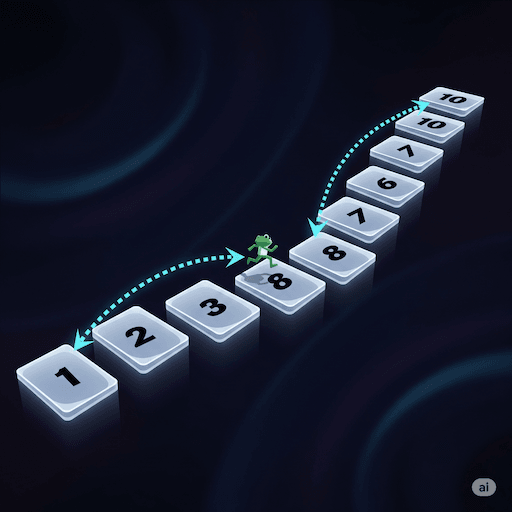 | In this coding interview, you'll solve an algorithmic problem about finding the minimum number of jumps
needed to traverse a magical stepping stone path. Each stone tells you the maximum number of steps
you can take forward from that position.
|